Showing posts with label Dharma. Show all posts

Tuesday, October 9, 2018

Experimenting With A Product

     Do you like to run experiments when you discover a product you've never used? I think I originally became a scientist because I love to do experiments. Now that I'm an artist, I find this skill handy and still fun. The product I'm writing about is called Fiber Etch. I found out about it from Jane Dunnewold when I took the Art Cloth Mastery Class and decided it had potential in my artwork so I ordered a bottle of it. Basically, it destroys cellulose-based materials, which means you can use it to selectively dissolve cotton fabric.  My friend, Angie Knowles, sent me a sample of a silk-cotton fabric she had purchased so that I could try Fiber Etch on it.
     Here's what I did and the results:
1.) I applied the Fiber Etch (which is a thick liquid a little thicker than maple syrup) through a thermofax screen onto the fabric.
the fabric wet with fiber etch
the thermofax design I used
2.) I let it dry overnight.
3.) I ironed it to heat-destroy the cotton fibers where the Fiber Etch had made contact.
the brown parts are where the cotton got destroyed

4.) I soaked it in warm water for about 10 minutes and softly rubbed it with my hands.
5.) I hung it to dry
6.) I ironed it flat and brushed it with a scrub brush (but gently) to remove any stray cotton fibers.
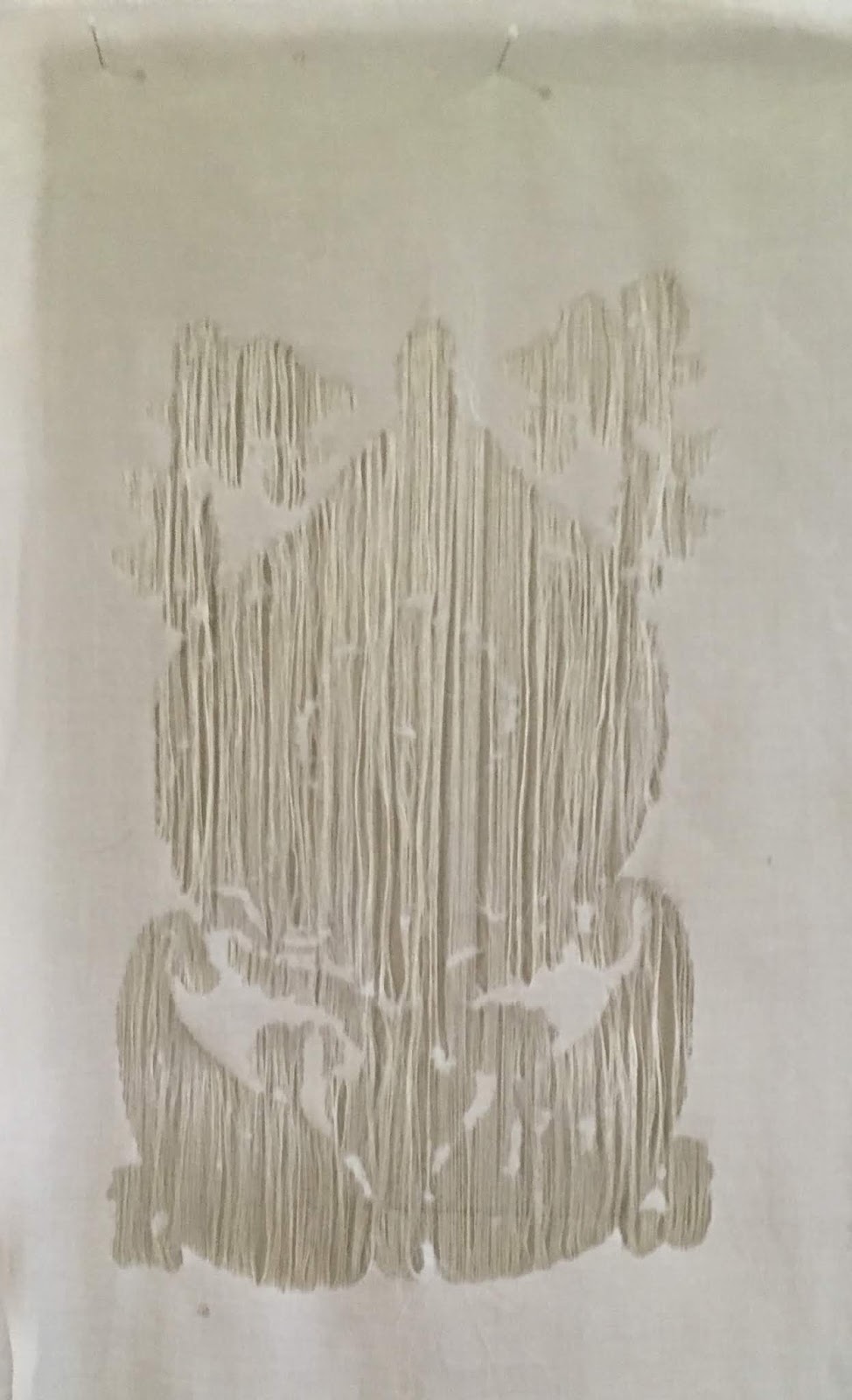
this design was not a good choice since it didn't keep the detail... too much cotton got destroyed.
I redid it with 3 other thermofax screens to try for a more suitable design for using with this product
You can see from the results that this particular fabric is made using silk woven in one direction and cotton in the other, so the result from the fiber etched parts is silk fibers running in one direction with no fibers woven with them in the areas that got etched. This works ok for designs with thin lines or thin shapes, but leaves an area too open for designs with bigger shapes.


7.) I put it in a dye bath of  procion MX dyes ( sun yellow mixed with mixing blue 50:50). (I chose this color mixture because I was aware that cotton turns a different green hue in it than silk does).
8.) Batched it for 24 hours, rinsed it, dried it, and ironed it.
the silk fibers dye a more yellow green and the cotton fibers dye a more blue-green. 
You can see the silk fibers running vertically in the etched areas. 

I had previously tried this product with a poly-cotton fabric in which the all the threads are a mix of cotton and poly. The result is more effective with this type of fabric because you end up with woven shapes in the etched areas, but they are thinner since all the cotton gets removed and only polyester remains. 
The remaining polyester threads (in the etched areas) don't accept the dye; only the cotton does.
So you end up with your thermofax-etched areas staying white
The whole cloth dyes lighter than expected since the polyester part doesn't accept the dye.
I have more things I want to try with this product, but this is a good start and I found it interesting to see how the thread structure plays a roll in the results. I'm linking this to Off The Wall Friday where you can find other art blogs. Please make comments on the artists' post to let them know you stopped by.  Thanks for visiting.


Friday, May 6, 2016

Learning A New Skill Set

     A huge part of the Art Cloth Mastery Class involves dyeing cloth which I only did for a weekend way back in about 2006 and again in this class for a couple of days in March of this year. My dyes from  Prochemical arrived in the mail a few weeks ago and so did some sample cotton fabrics I wanted to test out. Their arrival was very exciting, but it also meant that I was on my own to set up a dyeing station and begin working with them.
     The first thing I did was to dye several colors with each fabric type to compare the fabrics in order to choose which fabric I liked the best. I decided I liked the mercerized cotton broadcloth. So I ordered several yards from Dharma. I chose them because several friends recommended them and the cloth comes from the USA. Other companies couldn't tell me for sure where their cloth came from. It's also supposed to be PFD. Even so, I still scour it before I use it. (That means I wash it in hot water with washing soda.)
     When I began, all my colors came out too dark. It turned out I had not accounted for that fact that I had used only a small sample of cloth in each dye bath and I needed to recalculate the dye powder amounts also based on the weight of cloth used. Once I did that, I was back in business.
     The next thing I did was to dye two swatches of broadcloth for each dye color I had so that I can create a dye notebook. Then, I'll take one of the swatches and discharge sections of it (one section with bleach and one section with a product from Jacquard) to see what color it turns when discharged. Those will go into the dye notebook, also. That way I'll have a permanent record for each dye powder's effects on broadcloth.
swatches of each of 23 colors on broadcloth
     I got dots on two of the samples. (The dots keep appearing on the Basic Blue even after really mixing it, letting it sit, and filtering it through a nylon stocking. So I think the dye is precipitating back out of solution afterwards while it is batching.) I think that means my water may be too hard so I'm going to add some softener to my chemical water and try a sample and see if that helps. 
     While I was doing all those solids, I wanted to play a bit, so I did some clamping and folding on some leftover fabric samples after reading some blogposts and taking Jane Dunnewold's Craftsy class on dyeing and here is what I got:
Sample 1

Sample 2
Sample 2 was cut in that shape because that was all that was left of that piece of broadcloth.
Sample 3
     Sample 3 was my favorite. Those were just quick experiments. I can't wait until I'm doing real art cloths.  But the next few weeks will be spent on a huge research project for the class involving lots of dyeing of cloth that I can't share with you. I'll be learning so much and creating cloth and data for the other students in the class. They, in turn, will be doing their research projects to share with the class. It feels wonderful to be learning a whole new skill set. There is a big new world opening up to me with all sorts of possibilities to mix in with the skills I have already have. I love when a journey presents itself with a fork in the road.
     I'm hoping to add stitching to some of these cloths when I get some spare time in the next few weeks, too.
     I'm linking this to  Off The Wall Friday where you can find other art quilt blogs. Please make comments on their posts so that they know you stopped by. Thanks for visiting.